

Key takeaways from “Chronicles from The Manchester AI Ecosystem”,
AI Study Group — 19th May 2026
By Adrian Quayle
Adrian briefly introduced his background and career in management consulting in IT and business processes including his involvement in management system standards. After working across the UK and internationally for many years, he has been focussing on Manchester and the North-West of the UK, particularly through chronicling the Manchester AI Ecosystem. His talk is drawn from his experiences working in the corporate sector with Avasant, and latterly in the SME sector locally in AI with pliXos and Quantaleap.
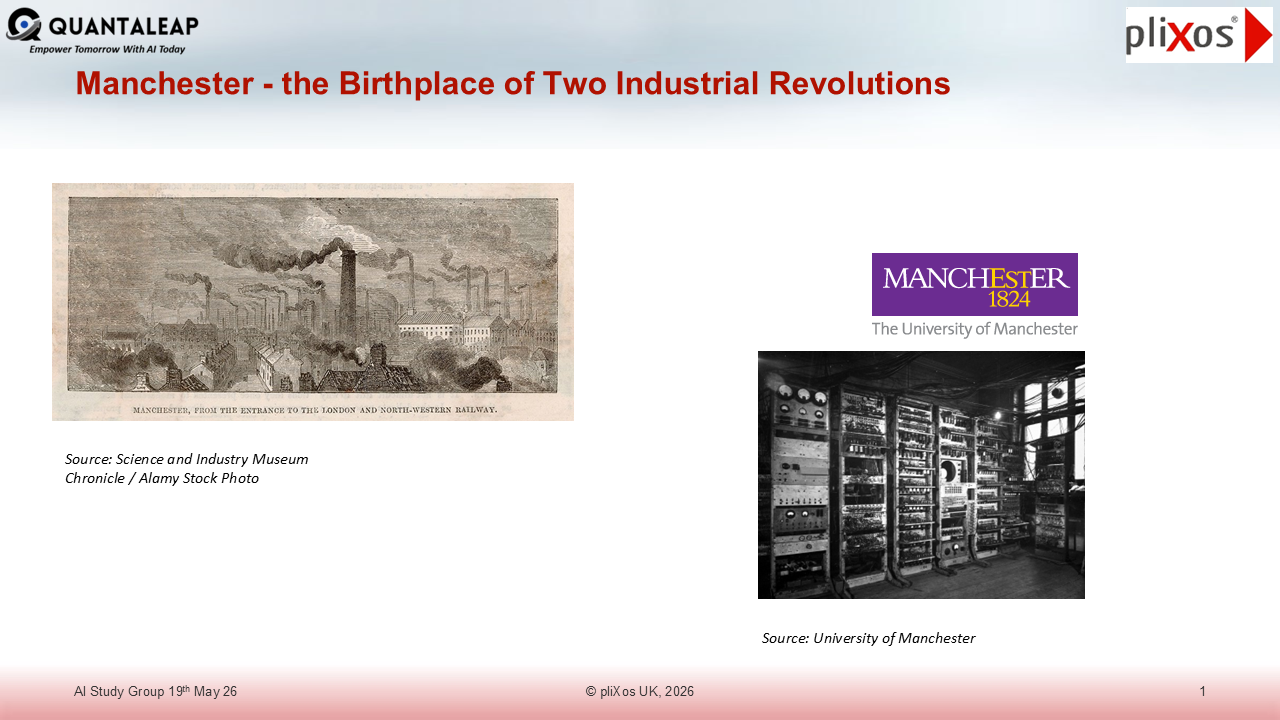
He opened the presentation by pointing out that Manchester was the birthplace of both, the first Industrial Revolution and the second, that of computing – he referenced the work on Baby computer at the University of Manchester 78 years ago. He drew a parallel between the origins and work of Manchester Statistical Society in surfacing the issues on improving social conditions during the Industrial Revolution and those raised by current technological revolution brought about by AI.
He then explored where we are in the AI journey and the AI landscape. Since ChatGPT 3.5 launched in November 2022, the pace of change has been staggering. He pointed to some of the major milestones following ChatGPT3.5’s launch including – the releases of ChatGPT4, Google’s Gemini, and Anthropic’s Claude. He touched upon the short-lived nature of projects like Sora and the appearance of autonomous agents like OpenClaw just four months ago.
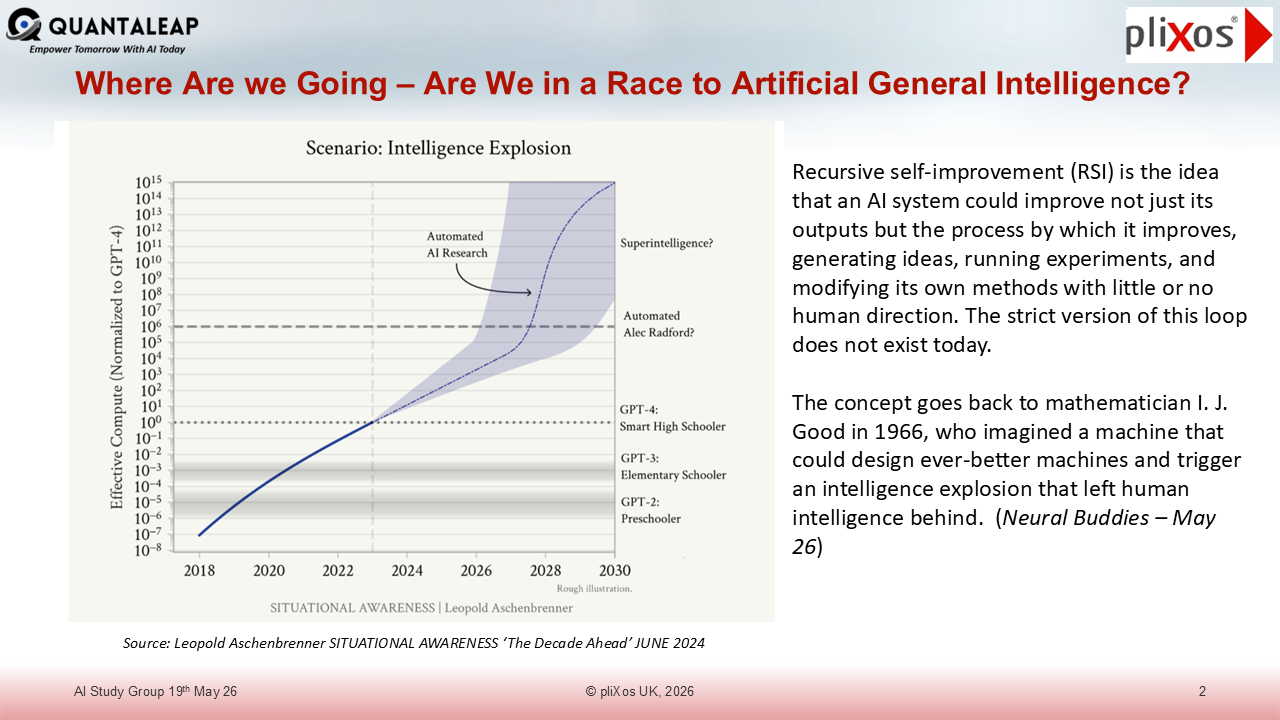
We’ve moved rapidly from early experimentation to AI embedded in everyday tools — and we are now debating whether we are on a path toward Artificial General Intelligence (AGI). In an AI world where Large Language Models (LLMs) are currently the pre-dominant form of artificial intelligence he questioned whether recursive self-improvement (RSI) could enable them to achieve AGI. He pointed to the definition of recursive self-improvement in the slide (shown in the figure below).
While RSI developing AGI appears still to be theoretical today, AI LLM model researchers are reporting that they are actively working toward it. He referenced the graph in Leopold Aschenbrenner’s ‘Situational Awareness’ paper from June 2024, which would suggest RSI is imminent.
He then discussed the rapid rate of change in, and all-encompassing impact of, AI in all areas of life – from our experiences in improvements in search and coding; through advances in physical AI, where a humanoid robot from Honor recently beat humans in the Beijing half-marathon; to models like AlphaFold which is now used extensively in the drug discovery process.
He pointed out that although LLM based models can do many things, they are fundamentally based on pattern recognition and can’t always ‘think’ through the question asked. He provided a cautionary note from his own experience: He had asked Claude to provide its official logo for this presentation. It offered a recreated SVG instead which vaguely resembled the logo totally confidently and when he had challenged it, Claude apologised and said it couldn’t hand over the actual logo as it was a ‘brand asset’— a small but telling reminder that LLM based AI systems have real limitations and boundaries we need to understand.
He then moved on to discuss how both individuals and businesses in the Greater Manchester area are getting to grips with AI and pointed out that individuals have been using AI for much longer that they may realise – Google Translate, Apple’s Siri, Microsoft’s Copilot (which has now been embedded in all their standard office packages) and more recently with ‘AI mode’ built into Google Search. Should individuals want to expand their knowledge of AI he pointed out there was a comprehensive set of free resources, such as DeepLearning.AI, Google’s AI learning paths, Microsoft Learn, and Coursera, which all also offer strong beginner content.
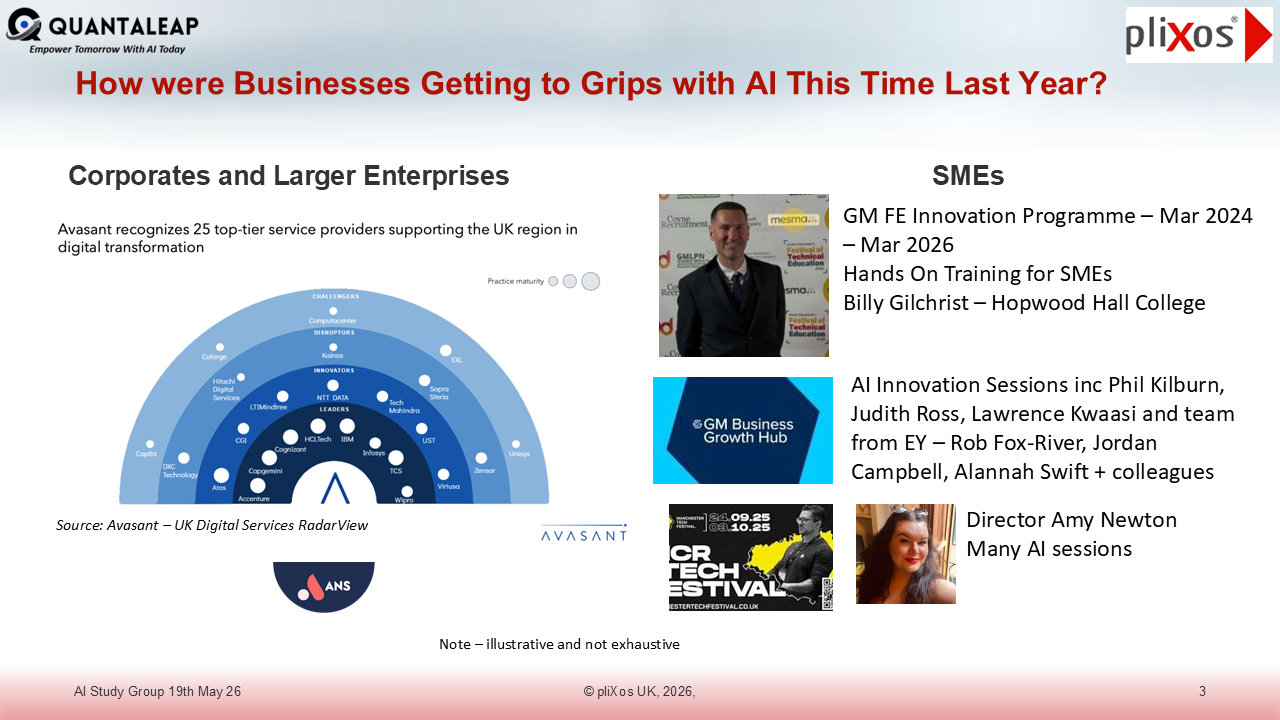
The pace of change also applies to the impact on support for AI implementation in businesses. both large and small. He mentioned how in 2023 all the IT/ BPO service providers in the UK, just nine months on from the launch of ChatGPT 3.5, where they had pivoted to branding themselves as AI companies. This meant that larger organisations who already had relationships with these service providers would be well catered for in accessing support for AI initiatives as such help would be additional to the resources being developed internally.
However, the situation for SMEs and smaller organisations is very different as they don’t have access to such AI support and implementation resources. Just 12 months ago (March/April 2024) in the Greater Manchester area there was very little by way of support that SMEs and other small organisations could turn to for help with AI. Among the few examples that existed were that provided by the Innovate UK funded GM Further Education Innovation Programme (through which ‘hands on’ training was provided by Billy Gilchrist from Hopwood Hall College), and various Greater Manchester Growth Hub sponsored workshops.
Roll on 12 months to today and Adrian stated that many organisations had sprung up to fill the gap. He pointed to several initiatives in the Region and beyond such as: No Code Lab AI, founded by Sara Simeone & Deborah Cleary in May 24; AI for Non-Techies (from Birmingham) by Heather Murray and Empower365 by Natasha Bradley. In addition, there are now many community-led Meetup groups including the AI Study Group, the AI Data Hive, and Practically AI in Greater Manchester. Interestingly he had discovered that the U3a (University of the Third Age) which caters for older people, has created much accessible, practical learning in AI for its members.
A notable initiative which potentially changes the market for smaller AI support organisations was the recent appearance in Manchester of the Intuit World Tour. In a session organised in conjunction with the Greater Manchester Chamber of Commerce, more than 50 people from a range of SMEs and smaller organisations participated in a half-day free vibe coding session at the Freight Island Conference venue in Manchester. Intuit are the global provider of packages such as QuickBooks and Survey Monkey. Other Software-as-a-Service companies are likely to follow suit in order to continue to remain relevant to their customers.
Adrian moved on to consider what is happening (or not) more broadly in AI in Manchester and the North-West of the UK. He presented the Roll of Honour of previous AI Study Group speakers and pointed out that it represented many individuals and organisation which were themselves key parts of the local AI ecosystem. This ecosystem roll of honour reflects genuine depth in the Region – from startups and scaleups to the North West’s universities and research institutions.
He then moved on to discuss what part Manchester could play to be at the leading edge of AI – the Third Industrial Revolution. He linked back to his initial slide on Manchester’s pivotal role in first two Industrial Revolutions. He argued that, if we accept the premise that AI factories are the industrial infrastructure of this era (referencing NVIDIA’s view); that inference is the key workload; that tokens are the new commodity, and compute translates directly to revenue and economic output – then Manchester and the North-West of the UK should have in place a substantial AI infrastructure including commercially available Data Centres. He also returned to the theme that AI was more than the LLMs which have almost totally consumed our attention, at present. He mentioned the ongoing work that has been conducted for many years in Symbolic AI and the recent launches of World Models.
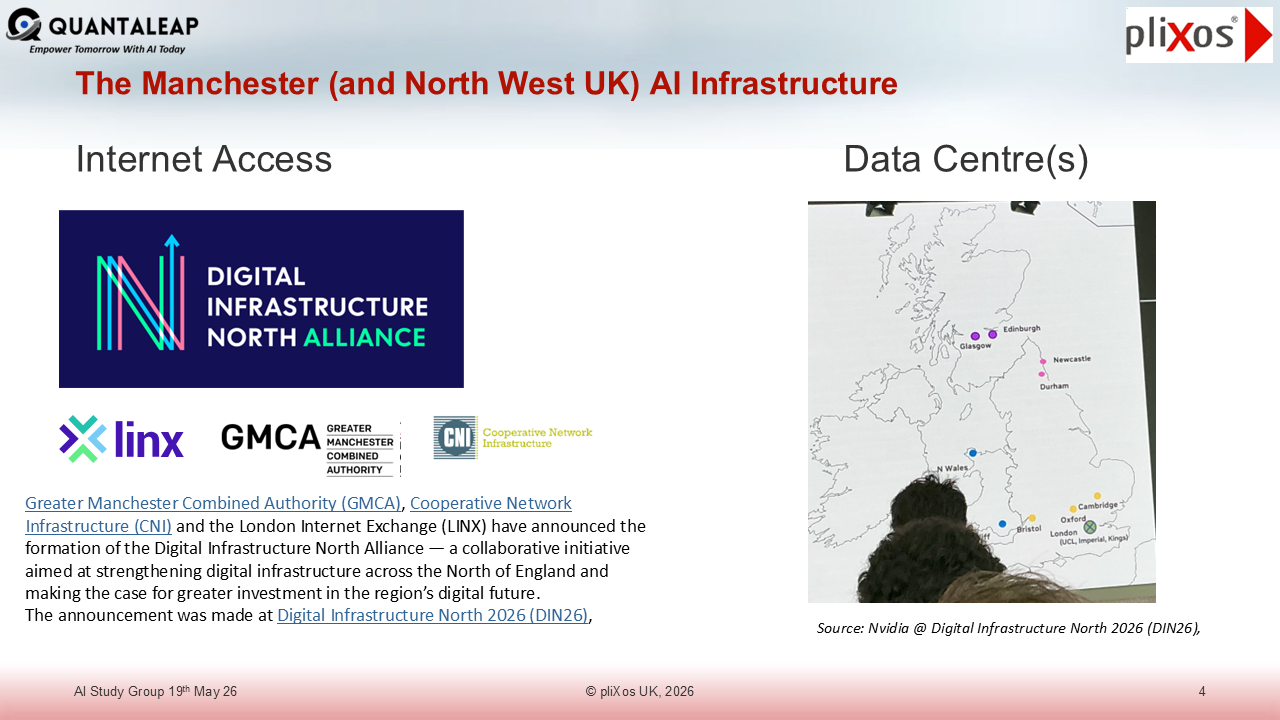
On the AI infrastructure front it was clear that Manchester and the North-West had direct access to both the global internet through the LINX Manchester exchange and potentially access to cheap power from offshore wind farms in the Irish Sea. Both the global internet fibre optic cables and the offshore electrical power cables come ashore at Blackpool.
Adrian mentioned that he had attended a conference the previous week at which the Greater Manchester Combined Authority, the local fibre optic Cooperative Network Infrastructure initiative and LINX, announced the Digital Infrastructure North Alliance, aimed at strengthening the region’s digital backbone and attracting further investment. However as shown in the slude below, Manchester and the North-West still lacked a commercially accessible AI Data Centre.
Adrian presented a slide which summarised some of the activity being carried out in the North-West in Neuro Symbolic AI across various universities. He suggested that bringing together the work in this area together with the strengthening of the LLM based AI infrastructure could provide the basis for a Manchester AI Model Collaboration. If the region could harness the work being carried out in local academic research with the local business AI Ecosystem and an enhanced (LLM) AI Data Centre infrastructure Manchester (and the North-West) could take its (rightful) place as a leading player in the Third Industrial revolution.
You have an opinion on this article or are interested in a direct discussion? Kindly contact Adrian at adrian.quayle@plixos.com.